Anthony and Hacine’s World Cup reunion
And Their Children After ThemAnthony and Hacine’s World Cup reunion turns a long-standing antagonism into a brief, practical truce, without pretending that one night of national celebration resolves their history. During France’s 1998 World Cup semifinal against Croatia, they recognize each other in L’Usine as the match swings from Croatian advantage to French victory. The shared celebration makes contact possible; after the crowds disperse, the two men speak of Anthony’s father and travel together through Heillange, carrying the possibility of renewed acquaintance without a promise of lasting reconciliation.
Arrival at L’Usine
Anthony reaches L’Usine with his cousin after the streets and bars fill with football supporters. They have been unable to find room elsewhere and arrive near the blast furnace just as halftime ends. Manu and Rudi are already at the bar. Croatia’s Davor Šuker scores, and the room falls silent; the change in the crowd’s mood makes the match’s uncertainty immediate rather than abstract.
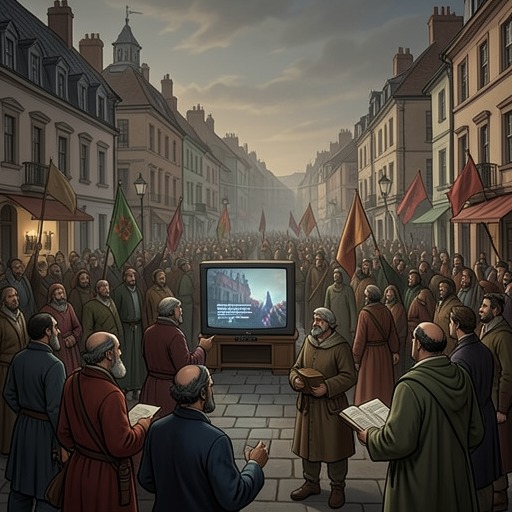
Hacine enters at that moment, orders a beer, and recognizes Anthony. Anthony recognizes him too. Their shared past does not prevent either from turning toward the television: the score and the game take precedence. When Lilian Thuram scores in the forty-seventh minute, the bar erupts. People shout, jump, embrace, and spill beer; Hacine raises both fists, while Anthony shakes him in the surge of celebration. For an instant, the two are not facing one another as opponents. They are caught up in the same public response to France’s goal.
A truce inside the crowd
The match continues amid drinking, smoking, and shouting from table to table. Anthony and his cousin buy rounds for one another and for Rudi, who becomes increasingly unruly in his support of the French team. Hacine drinks heavily as well. In the seventieth minute, Thuram scores again, and the victory that seemed uncertain becomes France’s passage to the final.
The narration presents the crowd’s unity as a powerful but temporary suspension of difference. Spectators are swept into a common celebration in which old debts and histories seem, for a moment, to have been erased. That imagined fraternity does not mean Anthony and Hacine’s conflict has been settled: when Anthony’s cousin leaves, he gestures toward Hacine and warns Anthony against doing anything foolish. Anthony answers that this is no night for them to fight. His decision is concrete and immediate—a refusal to turn their encounter into violence—rather than a declaration that the past no longer matters.
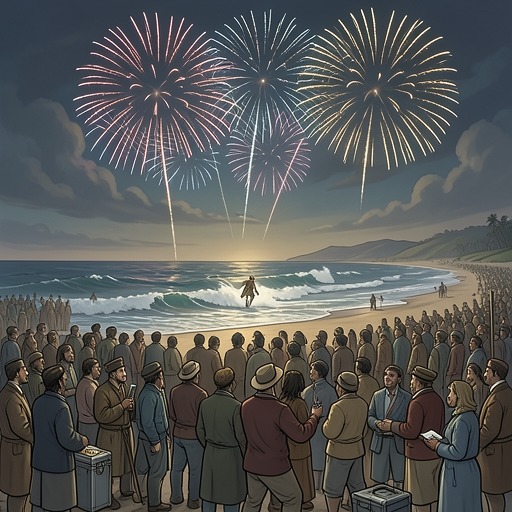
Outside the bar, Heillange’s celebration spreads through its streets. Cars jam the roads, flags appear at windows, and people toast one another; the town seems to rediscover its strength after years of hardship. A local reporter gathers reactions for the next day’s newspaper, while French and Algerian flags appear in the streets and the National Front office closes its shutter. The details complicate any simple picture of national unity: the celebration creates a shared public moment, but the town’s different signs of identity remain visible within it. The earlier Bastille Day fireworks had likewise drawn the valley’s attention toward a common spectacle. At the World Cup, however, that collective focus also places Anthony and Hacine, with their particular history, in the same room.
After the final whistle
Around midnight or one in the morning, Anthony and Hacine find themselves on the sidewalk outside L’Usine. The celebration has ebbed to scattered explosions and car horns, and the bars are sending home their intoxicated patrons. Anthony is unsteady and leans against the wall to light a cigarette. During the evening he has talked and drunk with many people, especially Rudi, who ends up beneath a table while children smear his face with burnt cork. Anthony and Hacine, by contrast, have made a point of avoiding one another.
It takes the late hour, alcohol, France’s victory, and the night’s mood of amnesty for one of them to speak. Hacine approaches with his hands in his pockets and begins by acknowledging how extraordinary the evening has been. Anthony agrees. Beside them stands the illuminated shell of the blast furnace, an industrial landmark that gives their hesitant conversation a setting far removed from the crowded bar. They do not immediately know what to say, and the exchange develops by pauses rather than by a sudden, complete account of their past.
Anthony tells Hacine that his father died exactly two years earlier. The disclosure marks a change in their conversation: Anthony checks Hacine’s face for a response, then concludes that the information settles something and belongs to the past. Hacine asks what happened to his father. The question is not evidence that their antagonism has vanished, but it is a direct response to a personal loss that had remained unspoken between them. The scene allows a small form of recognition to begin where the match’s collective excitement alone could not provide it.
The ride home
Anthony’s cousin has left him with a three-mile walk home, and Anthony asks Hacine to take him. Hacine eventually agrees, feeling proud after France’s victory. The decision extends their truce beyond the bar: Hacine supplies the ride, and Anthony accepts it, though neither makes a formal reconciliation of their relationship.
As Hacine drives, Anthony clings to the motorcycle’s cargo rack. The streets bear the aftermath of the celebration—greasy paper, crushed cans, firecracker marks, and a few unsteady stragglers—and the night’s earlier euphoria has given way to an uneasy quiet. Hacine rides quickly and jerkily, accelerating and braking around the debris. Anthony, by contrast, takes pleasure in the ride and in the familiar sensations of wind, exhaust, and the small engine, which bring back memories and awaken his wish to drive. At a red light he asks to try the motorcycle; Hacine refuses. The refusal preserves a boundary even within their newfound ease. Their reunion ends not with a repaired friendship or an announced change of heart, but with a shared journey, an exchange about bereavement, and a limited willingness to be together without fighting.